Adding DB2 Datasources Using db2cli

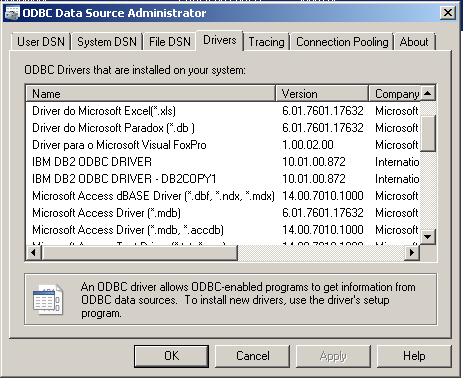
I recently blogged about Advanced Query Tool which I have started using on my VMs instead of one of the heavyweight IBM DB2 client tools.  AQT is a lightweight client that allows me to examine the databases easily but it works by reading in the datasources defined in Windows in the ODBC Manager.  To create datasources you must have some kind of DB2 client or driver installed.  I installed the minimal drivers which gives me this

Screen Shot 2015-03-23 at 11.18.05

Selecting ‘Configure DB2 .Net Data Provider” calls up a GUI interface that walks you through setting up a datasource.  To find the ODBC Manager under Windows 7 or 8 go to Control Panel and click on System and Security then click on Administrative Tools.

Screen Shot 2015-03-23 at 11.20.14

Each driver is configured to connect to a specific server and port.  The configuration is stored in db2cli.ini and db2dsdriver.cfg.  But what if you want to change the server or port address for a datasource.  Or in my case, add multiple datasources pointing to different servers?  Well you could try running the GUI tool again but that decision was made for me when Windows 7 decided to stop running the file and I decided I preferred to have more visibility / control of the configuration.  So instead I chose to use the command line to change and create new datasources.

Open an administrative command prompt and go to the DB2 client install directory (in my case c:\IBM\SQLLIB) and run

db2cli writecfg add -dsn PEOPLEDB_SA -database PEOPLEDB -host db2.turtlehost.net -port 50000

That writes a new datasource called PEOPLEDB_SA (you can call it what you want so long as it’s unique) that is connecting to a database called PEOPLEDB on server db2.turtlehost.net port 50000.  You don’t need to be able to connect to the database when you run the db2cli – it doesn’t validate or test at this point.

Now we need to add this newly created DSN to the Windows registry by running

db2cli registerdsn -add -alldsn

When you’re all done you need to restart Windows for the new registry to be read by AQT and you can go ahead and test the connection and use AQT to connect to the database by choosing the PEOPLE_SA datasource.

AQT Menu


Installation Manager Install Fails on Redhat 6.6

Starting a new Connections customer build this weekend I ran into a problem at step 1 – installing Installation Manager. I could install the console version using ./installc but the graphical version would bring up the product selection screen then crash before the license screen with a “JVM Terminated =1”.

After trying various things, new versions of java, using root instead of sudo (a known problem with earlier versions of IIM) I found the technote I needed.  This is a problem caused by a very specific combination of packages

RH6.5 or 6.6

GTK > 2.24

Cairo <1.9.4

Amazing I didn’t catch that right?  To tell what versions you have installed run

rpm -q gtk

rpm -q cairo

If your cairo version is out of date (which mine was) go to ftp://fr2.rpmfind.net/linux/sourceforge/f/fu/fuduntu-el/el6/current/TESTING/RPMS and download the latest version of cairo (in my case cairo-1.10.2-3.el6.x86_64.rpm)

then run rpm -U cairo-1.10.2.-3.el6.x86_64 .  Now IIM will run and install fine using ./install

Full details of the technote are here

Don’t Miss These Sametime Webcasts From IBM

IBM have three upcoming webcasts in April and May, all of which are definitely worth attending especially if you’re deploying Sametime Media elements.

April 8th   Serviceability Tool for IBM Sametime presented by Jeff Miller from the IBM Sametime team

The serviceability tool reviews your Sametime install , configuration and performance and outputs recommendations for you.

click here for details

April 15th Media Manager High Availability with Tony Payne and Jennifer Wales from the IBM Sametime team

click here for details

May 20th Sametime Troubleshooting Tips & Tricks with Tony Payne from the IBM Sametime team

click here for details

My Caffeinated Sessions At Social Connections

I’m delighted to say that I will be speaking at Social Connections in Boston this April.  It’s a great conference entirely about all aspects of Social Software and IBM Connections.  I like to try something different so I asked for 30 minute slots for my technical sessions this year

Staying On Top Of Connections Administration

From SSL certificates to setting up application security and rebuilding searches, we’ll cover how to identify the most common problems and resolve them quickly.

To do this we’ll also discuss how to set up logging and review both IHS and WAS logs and the key information you’ll need to supply IBM when opening any PMR (and where to find it).

I then have a session on Connections identities and LDAP with Terri Warren called

Who Does Connections Think I Am?

and one on designing a Connections environment – this one is only 15 minutes long.  You can give up 15 minutes to hear how to plan your Connections environment can’t you?

Connections Design From The Bottom Up

To see the full agenda for Social Connections or better yet, to register, click here

See you there!

Installing CR2 for IBM Connections 5

IBM have just released IBM Connections 5 CR2.  And by “just” I of course mean I haven’t had time to install it myself yet but let’s look at what’s going to be needed. Amongst the fixes there are a few new features that improve the use of CCM Libraries with Connections 5 utilising IBM Docs 1.0.7 (also released today).  For example you will now be able to edit Library files in IBM Docs without leaving Connections.  More details of those features here

The landing page for installing CR2 is here and includes a link to the update strategy document and a PDF with example instructions for updating a single server Windows environment.

You don’t have to upgrade to CR1 before going to CR2 but there are required database updates in CR1 you will still need to deploy on your way to CR2.  I’ve linked to them here so you don’t forget them.

I’ll be installing this week in my test environment but I won’t be looking to install for any customer in production for a few weeks.

CR1 Database Updates

CR2 Database Updates

CR2 Cognos Wizard

Filenet Updates (CR2 uses different Filenet versions from CR1 so don’t deploy the CR1 versions if you are moving directly from 5.0 to CR2)


IBM Docs 1.0.7 For Connections – Linux Not Required

The good news for many of my customers wanting to deploy IBM Docs is that version 1.0.7 has just been released and not only does it now support Windows 2012  (no Windows 2012 R2 but v1.0.6 only supported Windows 2008 R2) but previously the key IBM Docs Application and  IBM Docs Proxy required Linux as an operating system meaning we had to not only add at least one additional server but that server had to be Linux.  This was especially frustrating since the Conversion Server required Windows and wasn’t itself supported on Linux so to fully deploy IBM Docs 1.0.6 you needed at least one Linux AND one Windows server

As of 1.0.7 Windows 2008 R2 and Windows 2012 support all IBM Docs components.  Unfortunately the Linux operating system does still not support the Conversion Server but at least we have one OS to use if we want.  Full specifications here

Well done IBM.

IBM Docs on Windows


Engage UG In Ghent A Session And Rowdy Lunch

I’m very happy to say that Theo and the Engage.ug team have chosen one of my sessions (I sent in far too many submissions – sorry Theo!) to present this March in Ghent.   If you haven’t registered, it’s a great (FREE) European conference with a packed schedule and I can’t recommend it enough.  Go on and click the link above.  I’ll wait.

At 9am on Tues 31st in Room B I’m presenting “How To LDAP – Working With External Users In Connections ” where I attempt to show you all the options for adding and managing external users in your IBM Connections environment.

This isn’t the same session I did recently at ConnectED because I believe that attendees need some more detail on LDAP itself before they can make good decisions on how to configure and deploy it for external users so I’m modifying the presentation to add more technical grounding in LDAP to give context before moving on to external user configuration.  I hope you enjoy it.

I’m also doing a lunchtime session on Monday with Paul Mooney on “Changing your Technology”.  How do you adapt to changes in technology and how can you identify and harness the skills you take for granted?

“The Domino community is a vibrant, passionate world, but the market reality is now hard to ignore. You may be looking at the marketplace as it stands and thinking about the future. You may have spent a long time becoming well known in a technology set, only know to find it is going away. In this informal session, Paul Mooney and Gab Davis will share their own stories and explain how you’re a lot more valuable than you may think you are.  Expect a love of the Domino platform, a good dollop of positivity and a bit of painful honesty”

….We’re in Room A at 12.45 on Monday, bring lunch and shots of tequila..

Have Your Say – What Would You Like To See As A 2016 Event?

There’s a community led effort underway to get some feedback on what people who traditionally would come to Lotusphere/Connect(ED) would most like to see in 2016.  This is unauthorised by IBM but there are lots of options under discussion by them, by various user group leaders and other imaginative and enthusiastic people in our community.  Basically no-one wants to let an annual global event go away.   This has boiled down to a single question survey that is anonymous, requires no login and will take you about 10 seconds to complete.

Make your voice heard here

IBM Connected Part 3 of 3 – What Do I Do Next?

So ConnectED is over and the world has shifted a little bit more.  Going into this year the work I had been doing since 1996 on Mail systems had dropped from about 70%+ of my tasks to about 20% and had been replaced with projects around security, SSO, Connections, Sametime and other related WebSphere / DB2 systems.   Mostly that was because the use of mail systems has plateau’d and there is very little pushing at the boundaries going on so although everyone is still heavily dependent on mail , the systems pretty much ran themselves day to day.  The most upheaval we had last year was related to security updates.

I like working with complex technologies so my work around Sametime, Connections and SAML continues but I’ve also learnt that there are huge gaps in understanding around the supporting systems like LDAP and database servers that customers are struggling with along with their own ability to maintain and manage the built systems once in place.

Then there’s cloud.  As a system designer / installer / engineer / whatever – a move to the cloud in theory means I’m out of a job but I’ve never seen it like that.  I do this because I love to deliver systems that make people’s lives easier and continue to learn and develop myself.  An IBM’er said to me  “I don’t see why you are happy we are doing this in the cloud , surely you’ll be out of a job?”.  Leaving aside that I have no interest in holding customers back to maintain my own career, I wouldn’t get any sense of fulfilment from treading water.

I have projects spaced out across the year and I’m speaking at conferences hopefully in Belgium, Boston, Orlando (no not that one), Norway, Atlanta, UK etc.  However it’s the beginning of the year and I’ve been told no-one contacts me because they think I’m flat out busy – just to be clear, I’m never too busy to take on work 🙂

So where does that leave me?

Waiting

We’re in a transitional stage with Verse which is yet to appear outside of a limited beta in the cloud and is at least a  year away from on premises.  What that will change is still to be seen and I’ll wait and see and decide where I land once I understand more of what it delivers both in the cloud and on premises and the architecture behind it.  Other IBM products continue to add incremental features but nothing that would cause a seismic shift in my personal development strategy.

Teaching & Managing Supporting Technologies

The underlying technologies that these systems are dependent on are where many companies have gaps.  Nothing is as important as well structured and reliable LDAP.  LDAP directories are used for everything from authentication to data population , access rights and SSO.  One of the things I want to focus on this year is giving customers a better grasp of LDAP and how to build and maintain the best system they can.  Whether you are on premises or cloud, having a good directory is key to everything else you try to deploy.

DB2 and HADR.  Many IBM products require a Database server and all of them pretty much support Db2, where SQL and Oracle are supported and used there is usually an in house database server team.  However, many customers who come from a Domino background have very little DB2 experience because it’s never been needed and often what was the Domino team have to manage it.  DB2 databases need maintenance in the same way Domino databases need them. The server may keep running but your performance is going to take a hit.  I want to work this year on ensuring those customers who need DB2 systems have the right architecture and training to support it.  Basically what I’ve done for years with Domino.  You wouldn’t deploy Mail without understanding how to run a Domino server, and you shouldn’t deploy Connections without understanding how to run a DB2 server.

WebSphere is now pretty much aligned across products on 8.5x and it’s actually a fairly simple product to understand and manage. It’s just nothing like Domino.  There are plenty of WebSphere courses out there but most of them cover 10% of what you need to work with Connections and Sametime (maybe 25% of Portal) and the rest is irrelevant to your day to day work.  Along with doing lots of WebSphere only projects in the past 18 months I’ve also started doing WAS infrastructure design and workshop training for teams wanting to get up to speed with managing a  WAS environment.  I do the training via remote screen / web conference and it seems to work well as it has the advantage of me being able to use the customers own environment to train against.  I’ll be continuing to work with WebSphere architecture specifically related to Connections and Sametime but also standalone.

Connections101

I’ve fallen behind on Connections101 since losing my fellow editor Paul but I have content now written for building Connections 5 on a Linux platform.  Every time I think i’m done I decide to add a new piece like how to upgrade or add IBM Docs,  but I’m going to go ahead and publish what I have in hand and add to it once the site is live.  I’m also considering a Connections101 on deploying on iSeries. I just need to get my hands on an iSeries again (it’s been a few years since I owned one).

Are You Ready For Cloud?

With all the talk of Cloud and hybrid I believe many customers are at the stage of wondering if they should be moving and if they can move.  I have no incentive to recommend or not recommend someone move but I do understand that what salesmen often don’t tell you  or (to be fair) understand are the limitations of your existing business systems.

I am considering offering a provider agnostic cloud assessment to help you understand what your own technical barriers to cloud may be and whether a hybrid solution will ever be an option for you.   If I am able to review systems and highlight what could move, what could possibly move if it’s changed and what can never move – I’m hoping it will help customers clear out the noise and be able to make a good strategic decision.   I’d basically like to help people understand if a cloud deployment is a viable option for them now or in the future.

Domino 

I’m still continuing to work with Domino and now most of my work is around healthchecks, consolidation, clustering, security and performance.  It’s encouraging to see most customers upgrading Domino to newer versions, I see fewer and fewer EOL (v6, v7) versions out there and it’s still my favourite product to work with.  I’m always delighted to get a new Domino project.

Sametime / Connections Chat

I’m doing a lot of work deploying the A/V elements of Sametime and designing global deployments.  Once more it’s important that when the install is complete, the in house team are able to understand and manage the environment. Especially with the media elements in Sametime which are so dependent on each other and on their interconnectivity.

Summary

So if you’re interested in deploying anything WebSphere related, in DB2, in building and managing LDAP, in Single Sign On across multiple different systems, in workshop training or in understanding if and when you might consider a hybrid cloud strategy – that’s what I’m hoping to be working on and talking about this year.  I foresee another shift towards the end of 2015 (or sooner if no-one is interested in those things :-))

What do you think?


IBM Connected Pt 2 of 3 – The Message

WARNING: This blog post uses the terms “Connect” “ConnectED” and “Lotusphere” interchangeably.  I suggest you do your own internal translation as you read.

So Connected is over and the sessions are done.  I would say I found it one of the best in years.  Certainly the content of the OGS and many of the other IBM sessions started to form a sensible strategy that I think customers can benefit from and for the first time in many many years I came away genuinely excited about the potential for the technology and the degree of innovation taking place.  Vague enough for you?  I’m sorry, I’ll get into detail in a little bit.

There was a lot of negative emotion understandably about this being the last Orlando conference (not officially but c’mon) but that aside it’s nice to hear IBM dial back on the CLOUD CLOUD and instead talk more about hybrid and mixed on-premises designs because I honestly believe that is the direction the majority of companies are heading.

So leaving aside the incremental improvements (TLS 1.2, critical view indexing, whiteboarding in mobile, video on smartphone, file transfer via mobile) and trying to put my thoughts into some kind of order let’s start with…

Verse

IBM’s new mail client seeks to innovate and re-imagine how we work with mail. I’m an engineer so when I use those words I don’t use them as marketing speak but in their real sense. The good news is that IBM are really on the right track here, focusing on design and using working “type” personas such as “the searcher”, “the on the go worker”, and “the assistant” to create ways to customise and interact.

The even better news is that there will continue to be a NSF database and therefore a Domino server underneath the hood.  Right now Verse is going to be cloud-only but we are promised an on-premises solution in the 2nd half of 2015.  Obviously one of the most powerful aspects of Verse utilises analytics and links to Watson allowing the client to make decisions for you and present the best and most important information to you all the time based on your previous behaviour and content.  I’m fairly sure we aren’t getting Watson on premises so it will be interesting how the integration will work but I can wait to see that.

In the meantime that NSF architecture extends your client choices from Notes, iNotes and Traveler to Verse, Notes, iNotes and Traveler and reassures existing customers they are on the right path.

There is a great website on Verse with demos of how it works and an explanation of the personas I highly recommend you read and sign up for the beta.

From my perspective this is by some way the most exciting direction in enterprise mail from any provider in as long as I can remember.  IBM are talking heavily about a freemium license and driving everyone to the cloud but I file that under ‘marketing wishful thinking’ and wait and see.  Right now my concern is the technology and that looks right.

Connections Next

Connections continues to be central to IBM’s social strategy, with v5 CR2  due out any day now and Connections Next due this year.  IBM continues to add new features and invest in the desktop and mobile clients.  It’s important to remember that things branded as “Connections” are often an interface to another product via Connections. For example Connections Content Manager adds Filenet integration, Connections Mail adds Domino or Exchange integration, Connections Chat adds Sametime integration, etc.  In 2015 we are told to expect more user customisation of Connections, such as the ability to create and synchronise folders and create, name and secure chat threads.

It’s interesting to see the investment in design carrying through to the new Connections next interface which has removed the emphasis on moving between applications like “Wikis” , “Blogs” and “Activities” and replaced this with a more cohesive experience around a single homepage showing what is most important to you (what you are working on, and what those you follow / network with are doing).  I wish I had photos of this and apologies that I don’t, I took some but was too far away from the stage for them to be any good.  We have said for some time that the “apps” menus make Connections seem too fragmented and it appears IBM are listening.

Once more, on-premises will be at least 6 months behind cloud as new features arrive but I’ve decided they can work out the bugs in the cloud before we install on premises 🙂

Mobile

I always enjoy hearing from the IBM Mobile team who in the past few years have been very open to feedback and suggestions from customers and business partners. One of the things that has come up time and again is the need for a single mobile client to handle mail, connections, chat, etc, instead of the individual clients we currently have and it looks like they have listened and produced that in the upcoming Verse client (initially iOS but then Android).  I’m sure it’s going to be cloud only initially but hope to see it support on premises when that becomes available towards the end of 2015.

So where does that leave customers?  If you are running Domino, Notes, Connections, Sametime (renamed as Connections Chat — euch) and are on-premises then you’re in a good place.  I think the path for most companies will end up being entirely on-premises or a cloud / on-premise hybrid with some commodity services in the cloud and business applications on premises.  At least as far as I can see.

What do I do next ? Well that’s for the next blog…